


Cold Steel, Warm Soul - Aviation Interior Stainless Steel 'Artistry' from Japan.
- Rick Roseman
- 2 days ago
- 10 min read

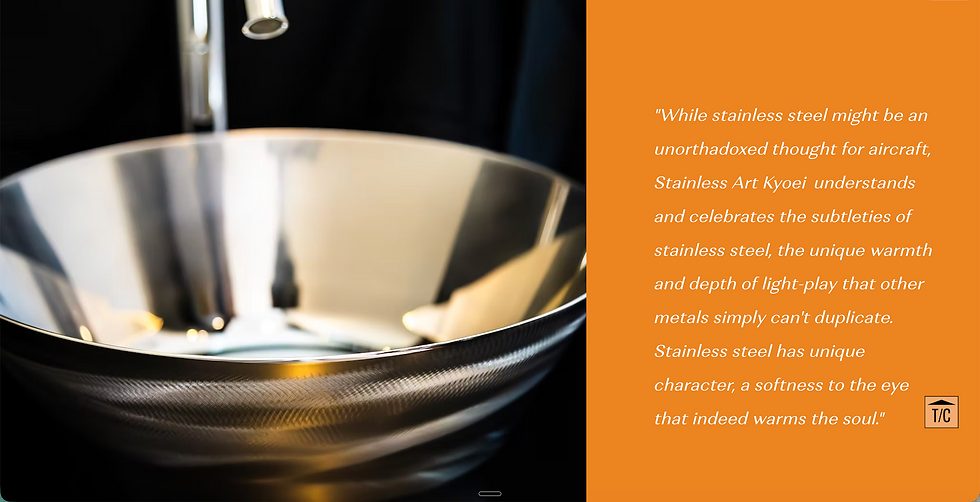
There are materials that whisper luxury, and materials that shout it. Leather does it with scent. Burl walnut does it with grain. Stainless steel, if we're being honest, has historically done neither — content to play the supporting role: the galley fixture, the lavatory basin, the part you clean but never really notice. Stainless Art Kyoei wants to change that conversation entirely. Based in Japan, SAK has spent decades mastering the art and science of precision stainless steel fabrication — not the industrial-cold, fingerprint-magnet variety that gives the material its unglamorous reputation, but something altogether different: surfaces finished with hammered tsuchime textures, vibration patterns, and hand-etched detail that evoke the same devotion to craft found in a Japanese sword-maker's workshop. It is steel that catches the light gently. Steel that feels warm to the touch. Steel that, in the right hands, belongs in the same sentence as the finest materials on earth. Now, in collaboration with interior design firm Altea, SAK is making a deliberate move into the business aviation market — and the timing may be exactly right. As today's ultra-high-net-worth jet owners push their completions teams toward more distinctive, more personal, and frankly more interesting material palettes, stainless steel — handled with this level of artistry — presents a genuinely compelling alternative to the plated metals and coated finishes that have dominated cabin metalwork for decades.
Q&A Begin...
Let's start with the elephant in the room — or rather, the heavy metal in the cabin. Stainless steel has a reputation for being, well, heavy. How does SAK address the weight challenge for aviation applications, and what has your collaboration with Altea taught you about engineering for aircraft-grade requirements?
SAK: Weight is certainly a critical consideration in aviation, where every gram matters. However, we believe the real question is not the weight of a material alone, but how effectively the entire system performs once all requirements are taken into account.
Because stainless steel offers exceptional strength, it can often be engineered into thinner sections while maintaining structural integrity. This allows us to minimize weight increases while delivering outstanding durability, safety, and long-term reliability. Rather than focusing solely on initial weight, we evaluate materials through the lens of total lifecycle value.
Working with aircraft-level requirements has reinforced an important lesson: engineering is rarely about optimizing a single parameter. Safety, reliability, durability, maintainability, passenger comfort, and aesthetics must all coexist within a highly constrained environment.
Aircraft interiors are expected to perform flawlessly for decades under demanding operating conditions. As a result, the challenge is not simply making a component lighter or stronger. It is achieving the greatest possible functionality, beauty, and longevity within a finite weight budget.
Our collaboration with Altea has been invaluable in this regard. It has helped us further refine our approach to balancing craftsmanship, material innovation, and the rigorous engineering standards expected in business aviation. In many ways, it confirmed something we have always believed: true luxury is not about excess—it is about intelligent optimization.
“The right light at altitude doesn’t just set a mood — it rewires how your brain processes the journey. It’s the difference between arriving depleted and arriving luminous.”

There's a moment when someone touches a beautifully finished stainless steel surface and it doesn't feel like what they expected. Can you describe what your tsuchime (hammered) and vibration-finished surfaces actually feel like to the hand — and why that tactile experience matters in a private jet interior?
SAK: Stainless steel should never be judged solely by the material itself. Its character is transformed by the way it is finished. At SAK, we believe the experience begins not when you see a surface, but when you touch it. That moment of contact is part of the design.
Our tsuchime (hammered) finishes create subtle variations that interact with light and movement, while our vibration finishes generate flowing patterns that feel almost organic. The result is often surprising. People expect stainless steel to feel cold, rigid, and industrial. Instead, they encounter a surface that feels alive—one that invites exploration rather than simply observing.
In a private jet cabin, passengers interact with materials at a very personal level. A handrail, a cabinet pull, a lavatory fixture—these are small moments, but they shape the overall impression of the space.
When someone touches one of our surfaces and instinctively pauses for a second look, that is when our stainless steel stops being a material and becomes an experience.
Plated metals are everywhere in luxury cabins — gold, chrome, brushed nickel. What does stainless steel offer aesthetically that plating simply can't replicate, and how do you respond when a designer says "but we could just plate it"?
SAK: Plating can create beautiful appearances, but beauty and material integrity are not always the same thing. The unique advantage of stainless steel is that its performance and its beauty come from the same source—the material itself. Its corrosion resistance, strength, and durability are not applied to the surface; they are inherent to the metal.
As a result, even if a surface experiences years of use, minor scratches or wear do not compromise its fundamental performance. The material continues to age with dignity.
When a designer says, “We could simply plate it,” our response is that plating changes how a material looks. Stainless steel changes how a material lives.
We are not interested in decorating a surface. We are interested in revealing the character that already exists within the material itself. For owners seeking authenticity rather than imitation, that distinction becomes increasingly meaningful over time.
Your work draws deeply on Japanese craft traditions. For readers who may not be familiar with the connection between, say, samurai sword-making and a lavatory sink, can you walk us through how those traditions actually inform your fabrication process — not just philosophically, but technically?
SAK: When people hear about Japanese craftsmanship, they often think of philosophy or tradition. For us, it is something much more practical. The essence of Japanese manufacturing is the belief that the parts a customer never sees deserve the same level of attention as the parts they do.
A master sword maker does not focus only on the visible beauty of the blade. Every stage of the process contributes to performance, durability, balance, and reliability. The same mindset guides our work today.
Whether we are forming a complex stainless steel component, refining a weld, or finishing a surface by hand, the objective is not simply to create a beautiful object. It is to create something that performs flawlessly throughout its life.
That philosophy influences technical decisions every day. It affects tolerances, inspection standards, finishing methods, and even how we approach manufacturability and maintenance.
For us, craftsmanship is not the opposite of engineering. It is engineering practiced with a deeper sense of responsibility to the person who will ultimately use the product.
Private jet interiors live and die by how materials age. A cabin may fly for 20-plus years. How does a SAK stainless steel surface hold up over time compared to plated or coated alternatives — and is there a maintenance story here that completions centers and owners should know about?
SAK: Private jet interiors are judged not only by how they look on delivery day, but by how they perform ten or twenty years later. Plated and coated finishes can achieve remarkable visual effects, but over time they may be susceptible to wear, peeling, or the gradual accumulation of surface damage. Stainless steel is fundamentally different because its corrosion resistance and durability are built into the material itself.
Even when surface marks appear through years of use, the material retains its structural integrity and can often be restored through refinishing rather than replacement. With proper care, its appearance can be preserved for decades.
What makes stainless steel particularly compelling is that it does not simply deteriorate—it evolves. Certain finishes develop a richer character over time, adding depth and authenticity to the cabin environment.
From a maintenance perspective, many surfaces can be refreshed through polishing or repair without replacing the entire component. For completion centers, this can reduce lifecycle costs. For owners, it helps preserve both the aesthetic and financial value of the aircraft.
We often say that stainless steel is not merely a decorative material. It is a material capable of being designed for decades, not years. In an environment as long-lived as a private jet cabin, that distinction becomes especially valuable.
We love the idea of an etched stainless steel panel next to hand-stitched leather and book-matched walnut veneer — but does stainless steel actually play well with others? How do your surface treatments harmonize with the warm, organic materials that dominate today's private jet interiors?
SAK: We actually see stainless steel as a material that elevates luxury materials rather than competing with them. Natural materials such as leather, walnut veneer, stone, and fine textiles bring warmth, richness, and personality to an interior. However, when used alone, a space can sometimes feel visually soft or overly heavy. Stainless steel introduces definition. It provides precision, contrast, and refinement.
When finished with techniques such as etching, hairline brushing, bead blasting, or tsuchime texturing, stainless steel does not appear cold or aggressive. Instead, it captures light gently and creates subtle visual rhythm throughout the cabin.
The finest private jet interiors are rarely built around a single material. They achieve their character through carefully orchestrated relationships between different materials, each contributing something unique. We believe stainless steel belongs naturally within that palette. Like leather and wood, it develops a story over time. Like stone, it conveys permanence. Yet it also brings a level of precision and clarity that few natural materials can achieve. Our goal is not to showcase metal. It is to create timeless interiors where warmth and precision coexist in perfect balance.

Walk us through your fabrication process for an aviation piece from blank sheet to finished component. Where does the artistry end and the aerospace engineering begin — or are they, in your view, the same thing?
SAK: A single sheet of stainless steel may pass through cutting, laser processing, forming, welding, polishing, surface finishing, and inspection before becoming an aircraft component.
Yet we do not view these as separate manufacturing steps. We see them as chapters in the same story.
Achieving a bend tolerance within fractions of a millimeter, or creating a weld that appears seamless, is engineering in its purest form. These details directly influence safety, durability, and long-term performance.
At the same time, the way light reflects across a surface, the way a texture feels beneath the hand, or the emotional impression created by a finished component requires something beyond engineering alone. It requires human judgment and aesthetic sensitivity.
Many people assume artistry and engineering occupy opposite ends of a spectrum. In aircraft interiors, we believe the opposite is true. A beautiful curve is often structurally efficient. A seamless finish enhances not only appearance but also cleanability and durability. Beauty and functionality are not competing objectives; they are different expressions of the same solution.
For us, there is no point where artistry ends and engineering begins. The highest-quality aircraft components are beautiful precisely because they have been engineered correctly.

What are the cabin touchpoints beyond the lavatory sink where you see the strongest case for stainless steel? Galleys, handrails, decorative panels — where would a bold interior designer be most surprised by what SAK can deliver?
SAK: Lavatory basins are perhaps the most familiar application for stainless steel, but we believe the greatest opportunities lie elsewhere—particularly in the areas passengers touch every day.
Door handles, cabinet trims, galley work surfaces, storage hardware, table mechanisms, decorative seat components, and architectural accent panels all present exciting possibilities.
These touchpoints must satisfy demanding requirements for durability, corrosion resistance, hygiene, and maintainability. In business aviation, they must also contribute to the sensory experience of the cabin. Stainless steel is one of the few materials capable of excelling in all of these areas simultaneously. Advances in etching, PVD finishes, and proprietary surface treatments now allow designers to move far beyond the traditional image of stainless steel as an industrial material. It can become a signature design element—one that is distinctive, tactile, and highly personal.
The most surprising application may not be where stainless steel replaces another material. It may be where it creates an entirely new design language.
You're a precision fabricator entering one of the most regulated manufacturing environments on earth. What has the certification and compliance journey looked like, and what should a completions center know before specifying a SAK component for the first time?
SAK: As we enter the aerospace sector, our primary focus is not certification itself—it is building a quality system capable of delivering consistent, repeatable excellence.
Today, SAK operates under JIS Q 9001 quality management standards, with structured processes governing manufacturing, inspection, and delivery. These systems provide the foundation upon which we are expanding our aerospace capabilities. The aviation industry understandably demands even higher levels of traceability, documentation control, configuration management, and risk management. We are systematically strengthening our processes to meet those expectations while leveraging the manufacturing discipline we have developed over decades. For aircraft interior components, quality is not simply about meeting a drawing. It is about ensuring that the same level of performance and appearance can be achieved consistently, year after year. What we would like completion centers to understand is that we do not aspire to be merely a component supplier. We aim to be a long-term partner who shares the same commitment to quality, reliability, and continuous improvement.
Our experience in stainless steel fabrication, combined with the quality culture deeply rooted in Japanese manufacturing, gives us a strong foundation as we move toward the standards expected in aerospace.
Finally — if you could put one SAK piece in front of a private jet owner who has never considered stainless steel as a luxury material, what would it be, and what would you want them to feel when they touched it?
SAK: If I could place only one piece in front of a private jet owner, it would not necessarily be a cabin component at all. It would be an object that captures the full potential of stainless steel—and the human craftsmanship behind it. It would not need to be large. It would simply need to reveal what is possible when precision engineering and hand-finishing come together in a single piece. When people first encounter our work, we often hope for the same reaction:
"Is this really stainless steel?"
That moment of surprise is important. Then we hope they feel compelled to reach out and touch it. To experience the texture, the reflection of light, the subtle details that cannot be appreciated through photographs alone.
At SAK, we care deeply about that moment of connection between a person and an object. We do not design only for appearance. We design for curiosity, for touch, and for emotional response.
And if, after experiencing the piece, someone asks, “Who made this?” then we have achieved something meaningful. Because at that moment, the object has begun to communicate the spirit of the craftspeople behind it and the values of Japanese manufacturing itself.
"Our goal is not simply to showcase metal. Our goal is to move people."
Through stainless steel, we hope to create something that transcends function and quality—a lasting emotional experience.
END INTERVIEW
For more information on Art Kyoei, use the links below.https://www.sa-k.co.jp/lavatory-sinkyoneyama@nisshin-global.comhttps://altea-aero.com/ robin.dunlop@altea-aero.com
Where Innovation Creates Your Solutions.
技術と発想で、ものづくりの答えを形にする


Comments